
At a glance
- Common name
- Dandelion
- Botanical name
- Taraxacum officinale
- Family
- Asteraceae
- Parts mentioned in historical records
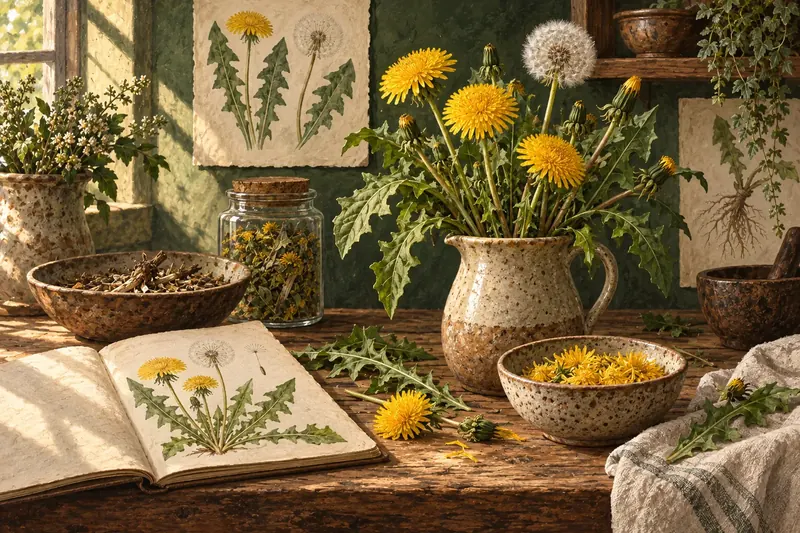
- Root (roasted as coffee substitute or decocted), leaves (fresh or infused), flowers (syrups, wines).
- Traditional correspondences
- Jupiter; Air / Earth
 Open on Amazon ↗
Historical record
Name derives from French 'dent-de-lion' (lion's tooth). Celebrated in Traditional Chinese Medicine (Pu Gong Ying) and Arabic medieval medicine for purifying blood and clearing toxic heat.
Folklore and mythology
Blow the fluffy seed parachute head to carry wishes upon the wind or count how many years remain until marriage. Steeping the roasted root tea induces psychic receptivity and connects with underworld spirits.
According to Greek legend, Theseus dined on dandelion leaves for thirty days to gain the stamina, cunning, and physical fortitude necessary to vanquish the Minotaur inside the Labyrinth.
In Celtic tradition, dandelion was sacred to Brigid for its solar associations and early spring emergence.
Tradition: Greco-Roman & Celtic Brigid Associated figures: Theseus & Saint Brigid
Mystical correspondences
Correspondences vary by tradition and source.
Is dandelion safe to use?
Historical and spiritual associations do not establish that Dandelion is safe or effective. Do not use this page as instructions for ingesting, smoking, inhaling, or applying Dandelion.
For current safety information, check a health authority or ask a qualified clinician or pharmacist, especially during pregnancy or lactation, while taking medication, or with an allergy or health condition.
Exposure note: EPA indoor-particle guidance says burning can add particles and advises ventilation. ASPCA plant entries address ingestion, not smoke exposure. See the sourced burning, pet and pregnancy lookup; neither source clears this plant as safe to burn.