
Is deadly nightshade safe to use?
Do not purchase or use Deadly Nightshade / Belladonna.
Deadly nightshade is poisonous. NC State Extension identifies tropane alkaloids as toxic constituents and lists the plant's leaves, roots, flowers, berries, and other parts as poisonous. Do not taste or harvest it, and keep it away from culinary plants.
Do not use this page as instructions for ingesting, smoking, inhaling, or applying Deadly Nightshade / Belladonna.
This page is lore only.
Exposure note: EPA indoor-particle guidance says burning can add particles and advises ventilation. ASPCA plant entries address ingestion, not smoke exposure. See the sourced burning, pet and pregnancy lookup; neither source clears this plant as safe to burn.
At a glance
- Common name
- Deadly Nightshade / Belladonna
- Botanical name
- Atropa belladonna
- Family
- Solanaceae
- Plant parts
- Leaves, flowers, roots, and berries
- Traditional correspondences
- Saturn; Water / Earth
Identification and look-alikes
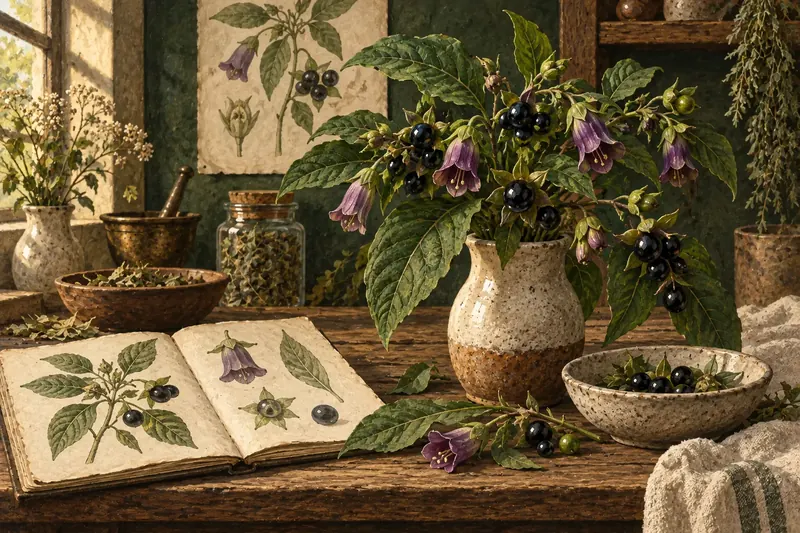
Atropa belladonna is a branching herbaceous perennial with paired upper leaves, drooping bell-shaped flowers, and glossy purple-black berries. The berries grow singly in the leaf axils. Berry color alone is not enough to distinguish a poisonous plant from an edible one; never harvest wild berries based on a common name, photograph, or this illustration.
Historical record
Historical accounts link deadly nightshade with poison and with a cosmetic practice behind the name “bella donna.” These accounts describe the plant's history, not a use recommendation.
Folklore and mythology
Later European folklore linked the plant with flying-ointment stories and witchcraft. Those stories are historical lore, not instructions for handling or use. Folklore also held that the plant was tended by the Devil himself.
Named for Atropos, the eldest of the three Greek Fates (Moirai), who cuts the thread of human life. Associated with Hecate, goddess of witchcraft, crossroads, and poisonous herbs.
Some accounts place these flying-salve stories at Brocken Mountain and call the plant the Devil's garden.
Tradition: Greco-Roman Witchcraft Associated figures: Atropos & Hecate
Mystical correspondences
Correspondences vary by tradition and source.
Name reference
- The RHS pairs Atropa belladonna with the common name deadly nightshade in its plant profile.
- NC State Extension's plant profile describes the leaves, flowers, fruit, and toxicity.
- Poison Control's plant list includes deadly nightshade (Atropa belladonna).