
At a glance
- Common name
- Hawthorn
- Botanical name
- Crataegus monogyna / oxyacantha
- Family
- Rosaceae
- Parts mentioned in historical records
- Berries, leaves, flowers (flowering tops)
- Traditional correspondences
- Mars / Venus; Fire / Water
 Open on Amazon ↗
Historical record
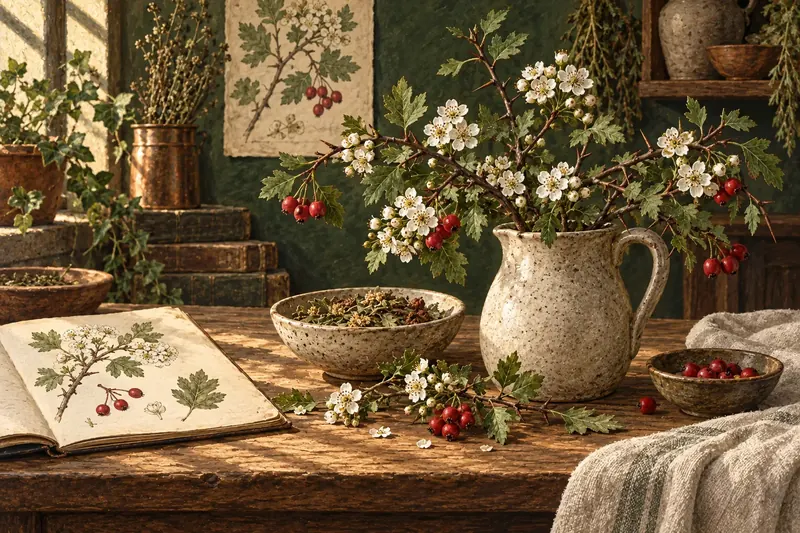
Known across the British Isles as the May Tree. Traditional heart restorative popularized in European medicine by 19th-century Irish physician Dr. Green.
Folklore and mythology
Together with Oak and Ash, Hawthorn forms the sacred fairy triad: 'Oak, Ash, and Thorn'. Solitary hawthorns growing on hillsides were venerated as portals to the Otherworld; cutting them down risked fairy curses.
Sacred to the Roman goddess Cardea, who guarded door hinges and protected infants against nocturnal specters with hawthorn branches. In Celtic lore, represents the Beltane celebration of sensual love.
One Roman account says Cardea used hawthorn boughs against night-flying striges, and blooming branches brought inside were said to smell like the Great Plague of London.
Tradition: Celtic & Roman Associated figures: Cardea, Flora & The Fair Folk
Mystical correspondences
Correspondences vary by tradition and source.
Is hawthorn safe to use?
Historical and spiritual associations do not establish that Hawthorn is safe or effective. Do not use this page as instructions for ingesting, smoking, inhaling, or applying Hawthorn.
For current safety information, check a health authority or ask a qualified clinician or pharmacist, especially during pregnancy or lactation, while taking medication, or with an allergy or health condition.
Exposure note: EPA indoor-particle guidance says burning can add particles and advises ventilation. ASPCA plant entries address ingestion, not smoke exposure. See the sourced burning, pet and pregnancy lookup; neither source clears this plant as safe to burn.