
Is mandrake safe to use?
This page is lore only. Do not purchase or use Mandrake.
Mandrake is a toxic plant in the Solanaceae family. The University of Oxford's Plants 400 profile describes Mandragora as hazardous because of tropane alkaloids; the Royal Horticultural Society also flags Mandragora officinarum as toxic if eaten. Do not ingest, burn, apply, or use it in fragrance or craft projects.
Exposure note: EPA indoor-particle guidance says burning can add particles and advises ventilation. ASPCA plant entries address ingestion, not smoke exposure. See the sourced burning, pet and pregnancy lookup; neither source clears this plant as safe to burn.
At a glance
- Common name
- Mandrake
- Botanical name
- Mandragora officinarum
- Family
- Solanaceae
- Plant parts
- Leaves, flowers, berries, and root
- Traditional correspondences
- Saturn / Mercury; Earth / Fire
Identification
Mandragora officinarum is a stemless plant with a rosette of large leaves and a thick taproot; it belongs to the Solanaceae family. A shaped root, folklore illustration, or marketplace name is not enough to identify an unknown plant. Do not use a common name or image as a substitute for botanical verification.
“American mandrake” is a common name for the unrelated mayapple (Podophyllum peltatum) in the Berberidaceae family. NC State Extension lists several parts of mayapple as poisonous. Shared common names do not establish botanical identity.
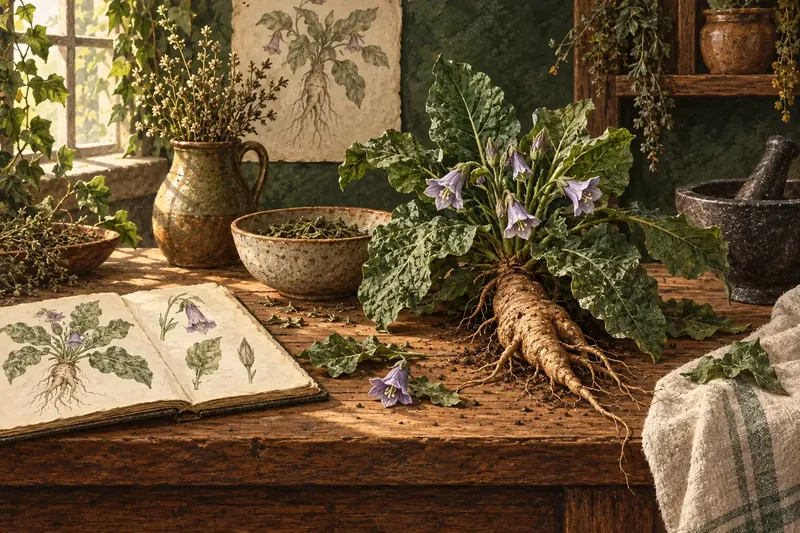
Historical record
Mandrake appears in ancient and later botanical writing, as well as in the biblical story of Rachel and Leah. Historical accounts are not instructions for present-day use.
Folklore and mythology
Believed to grow beneath the gallows from the seed of hanged men. Legend warned the root would emit a bloodcurdling shriek when uprooted, killing or driving mad anyone who heard it; black dogs were tied to pull it at night.
Later stories linked mandrake with Circe, Aphrodite, human-shaped roots, and flying-ointment lore. These stories belong to folklore, not a preparation or use guide.
Some traditions kept a mandrake root wrapped in silk as a household wealth idol.
Tradition: Biblical, Mesopotamian & Medieval Associated figures: Circe, Aphrodite & Hecate
Sourcing and quantity
This is a lore-only page. No purchase route or sourcing recommendation is provided for mandrake.
There is no project quantity to calculate here. Keep mandrake ornamental or educational and do not use it in pantry, body, fragrance, or ingestion projects.
Mystical correspondences
Correspondences vary by tradition and source.
Sources
- Kew accepts Mandragora officinarum and lists it in Solanaceae in Plants of the World Online.
- The University of Oxford's Plants 400 profile discusses mandrake's botanical identity and toxic alkaloids.
- The Royal Horticultural Society's mandrake profile flags the plant as toxic if eaten.
- NC State Extension's mayapple profile lists “American mandrake” as a common name for Podophyllum peltatum and describes its toxicity.