At a glance
- Common name
- Vervain
- Botanical name
- Verbena officinalis
- Family
- Verbenaceae
- Parts mentioned in historical records
- Aerial flowering parts
- Traditional correspondences
- Venus; Earth / Water
 Open on Amazon ↗
Historical record
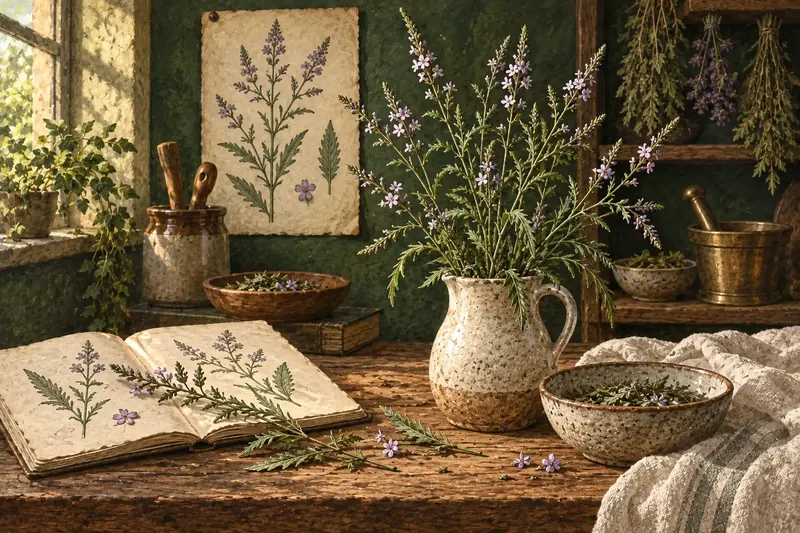
One of the most sacred plants of antiquity, hailed by Greeks as 'Hierobotone' (Holy Plant) and Romans as 'Herba Sacra'. Druids harvested it during Sirius rising without iron tools.
Folklore and mythology
Priests used it to scrub down altars of Jupiter before rituals. Held during negotiations to broker peace between bitter enemies. Worn as a protective amulet against vampire attacks, nightmares, and fever.
Sacred to Hermes/Mercury and Isis. In Christian legend known as 'Herb of the Cross' (Enchanter's Plant), believed to have been applied to Christ's wounds on Mount Calvary to arrest bleeding.
Druids were also said to harvest it with gold or silver sickles, while people carried it when seeking a truce.
Tradition: Druidic, Roman & Christian Lore Associated figures: Hermes, Isis & Jesus Christ
Mystical correspondences
Correspondences vary by tradition and source.
Is vervain safe to use?
Historical and spiritual associations do not establish that Vervain is safe or effective. Do not use this page as instructions for ingesting, smoking, inhaling, or applying Vervain.
For current safety information, check a health authority or ask a qualified clinician or pharmacist, especially during pregnancy or lactation, while taking medication, or with an allergy or health condition.
Exposure note: EPA indoor-particle guidance says burning can add particles and advises ventilation. ASPCA plant entries address ingestion, not smoke exposure. See the sourced burning, pet and pregnancy lookup; neither source clears this plant as safe to burn.