
At a glance
- Common name
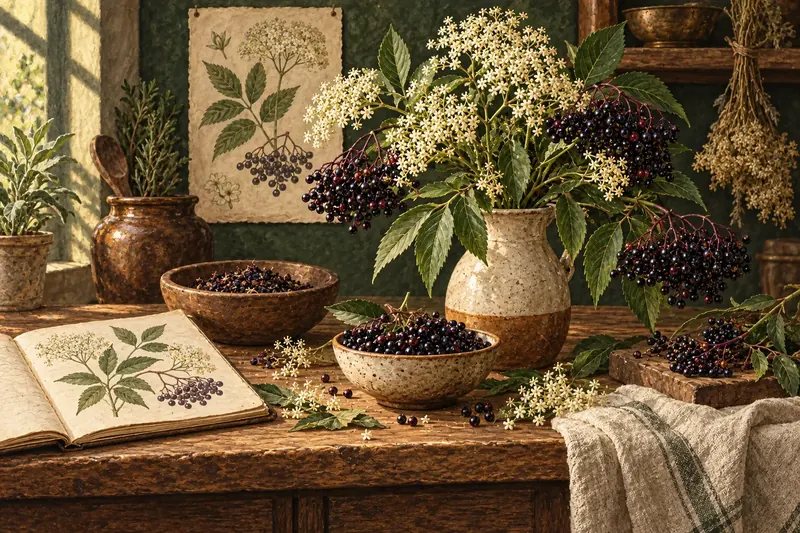
- Elderberry / European Elder
- Botanical name
- Sambucus nigra
- Family
- Adoxaceae
- Parts mentioned in historical records
- Berries (must be cooked), flowers
- Traditional correspondences
- Venus / Saturn; Water / Earth
 Open on Amazon ↗
Historical record
Known in Europe as the 'Country Medicine Chest'. Prehistoric archaeological sites reveal widespread human use. Hippocrates referred to the elder tree as his entire medicine chest.
Folklore and mythology
Guarded by the formidable 'Elder Mother' (Hyldemoer in Danish folklore). Wood was never felled or burned without chanting: 'Elder Mother, give me some of thy wood, and I will give thee some of mine.' To sleep beneath it invited fairy kidnapping.
Sacred to the Germanic goddess Holda (Hulda), protector of hearth, marriage, and childbirth. In Christian legend, also rumored to be the wood from which Judas hanged himself and from which the True Cross was fashioned.
Other lore warned against burning elder wood or making baby cradles from it, and treated gatepost plantings as protection from witches.
Tradition: Germanic & Celtic Folklore Associated figures: Holda (Hulda) & The White Goddess
Mystical correspondences
Correspondences vary by tradition and source.
Is elderberry safe to use?
Historical and spiritual associations do not establish that Elderberry / European Elder is safe or effective. Do not use this page as instructions for ingesting, smoking, inhaling, or applying Elderberry / European Elder.
For current safety information, check a health authority or ask a qualified clinician or pharmacist, especially during pregnancy or lactation, while taking medication, or with an allergy or health condition.
Exposure note: EPA indoor-particle guidance says burning can add particles and advises ventilation. ASPCA plant entries address ingestion, not smoke exposure. See the sourced burning, pet and pregnancy lookup; neither source clears this plant as safe to burn.