
At a glance
- Common name
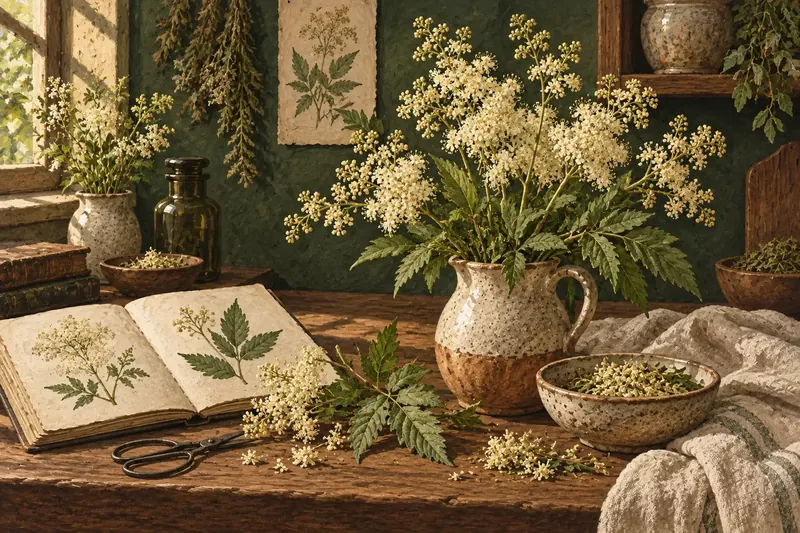
- Meadowsweet
- Botanical name
- Filipendula ulmaria
- Family
- Rosaceae
- Parts mentioned in historical records
- Flowering tops, aerial leaves
- Traditional correspondences
- Jupiter / Venus; Water
 Open on Amazon ↗
Historical record
One of the three sacred herbs of the Celtic Druids (with vervain and mint). In 1897, Bayer synthesized acetylsalicylic acid from its salicin content and coined the trade name 'Aspirin' from Spiraea (meadowsweet's old genus).
Folklore and mythology
Strewn across banquet floors in Elizabethan England; Queen Elizabeth I prized it above all other strewing herbs for its intoxicating honey-almond scent. Sprinkled in water to divine whether a thief would confess.
In the Welsh Mabinogion, the magical maiden Blodeuwedd ('Flower Face') was conjured by magicians Math and Gwydion out of the blossoms of meadowsweet, oak, and broom.
It was also worn in bridal headdresses.
Tradition: Celtic & Welsh Associated figures: Blodeuwedd & Celtic Druids
Mystical correspondences
Correspondences vary by tradition and source.
Is meadowsweet safe to use?
Historical and spiritual associations do not establish that Meadowsweet is safe or effective. Do not use this page as instructions for ingesting, smoking, inhaling, or applying Meadowsweet.
For current safety information, check a health authority or ask a qualified clinician or pharmacist, especially during pregnancy or lactation, while taking medication, or with an allergy or health condition.
Exposure note: EPA indoor-particle guidance says burning can add particles and advises ventilation. ASPCA plant entries address ingestion, not smoke exposure. See the sourced burning, pet and pregnancy lookup; neither source clears this plant as safe to burn.