
At a glance
- Common name
- White Sage
- Botanical name
- Salvia apiana
- Family
- Lamiaceae
- Parts mentioned in historical records
- Leaves
- Traditional correspondences
- Community-specific; no universal set
Historical record
White sage is a distinct plant native to California and Baja California, not the Mediterranean culinary sage of European kitchens. It has specific ceremonial significance in some Indigenous communities of the region; see the sourcing section for cultural context.
Source white sage responsibly
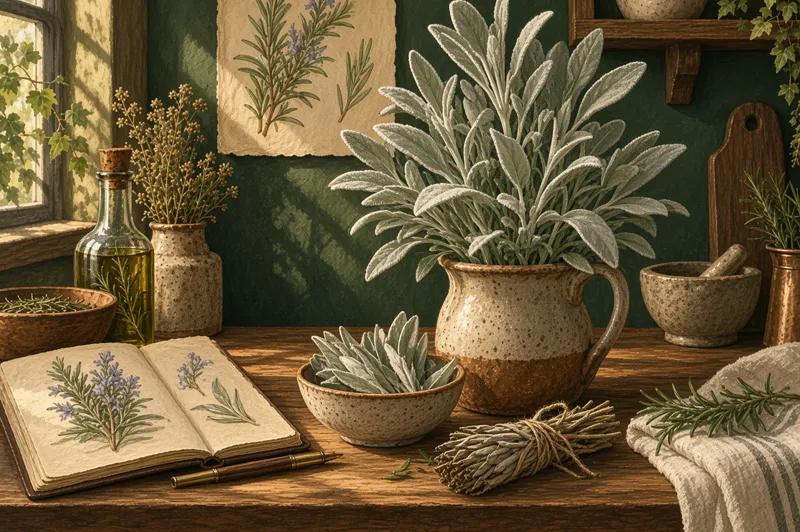
White sage (Salvia apiana) is a shrub native to California and Baja California, including coastal sage scrub habitat. Its oblong, scalloped-edge leaves are pale and silvery. These traits are useful botanical clues, but this page's illustration and short description are not field-identification tools.
White sage holds specific ceremonial and spiritual significance for some Indigenous communities of the region. The California Native Plant Society documents concerns raised by Indigenous advocates about cultural appropriation, commercial demand, and wild-harvest pressure. These living traditions are not interchangeable with casual home fragrance or smoke-cleansing practices.
If you encounter white sage in commerce, choose a seller that clearly identifies cultivated material rather than wild-harvested material. For fragrance or craft material, consider cultivated common garden sage, rosemary, or English lavender. WitchyPantry does not sell white sage or link to product listings for it.
Folklore and mythology
White sage carries community-specific significance in some Indigenous traditions. This page does not speak for those living traditions or treat them as one universal practice.
Tradition: Community-specific Indigenous traditions Associated figures: Vary by community and source
Mystical correspondences
Correspondences vary by tradition and source.
Is white sage safe to use?
Historical and spiritual associations do not establish that White Sage is safe or effective. Do not use this page as instructions for ingesting, smoking, inhaling, or applying White Sage.
Exposure note: EPA indoor-particle guidance says burning can add particles and advises ventilation. ASPCA plant entries address ingestion, not smoke exposure. See the sourced burning, pet and pregnancy lookup; neither source clears this plant as safe to burn.
Sources
- Kew's Plants of the World Online lists Salvia apiana as native to California and Baja California.
- The California Coastal Commission white-sage profile describes its leaves and habitat.
- The California Native Plant Society's cultural and conservation report centers Indigenous advocates' concerns about wild-harvest pressure.