
At a glance
- Common name
- Wormwood
- Botanical name
- Artemisia absinthium
- Family
- Asteraceae
- Parts mentioned in historical records
- Leaves and flowering tops
- Traditional correspondences
- Mars / Saturn; Fire / Air
Identification: wormwood and mugwort
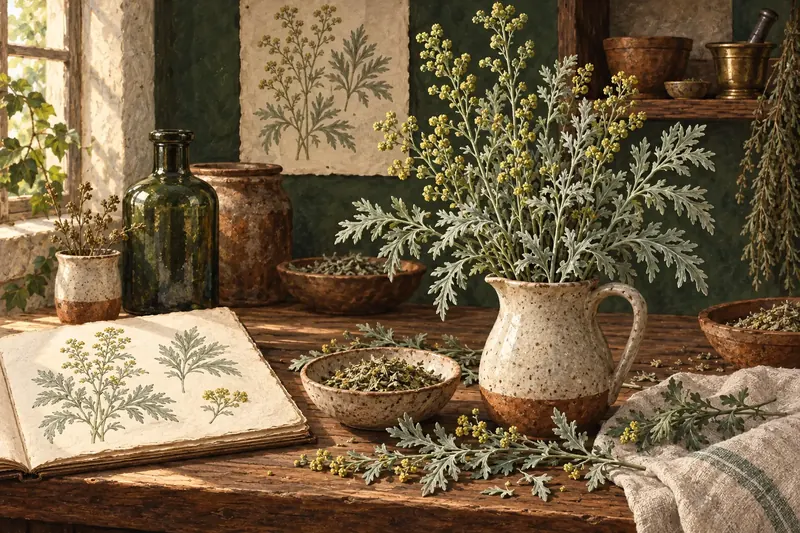
Wormwood (Artemisia absinthium) has deeply divided, silvery leaves with hairs on both surfaces. Mugwort (A. vulgaris) often has a green upper surface and a pale, hairy underside. These short descriptions are not a substitute for a regional botanical key or expert identification.
Historical record
Wormwood is associated with 19th-century absinthe, sometimes called the “Green Fairy.” This historical reference is not an instruction for consuming the plant or beverage.
Folklore and mythology
Some folklore links wormwood with spirit-calling and threshold charms. Historical accounts also mention wardrobe sachets, but this page does not recommend burning it or make claims about pest control.
Named after Artemis, yet associated with the bitter waters of divine retribution. In the Biblical Book of Revelation, the fallen star 'Wormwood' turns a third of the Earth's waters poisonously bitter.
Slavic lore also linked it with Rusalki and the ancestral dead, and some traditions scattered it at thresholds to repel apparitions.
Tradition: Biblical & Slavic Lore Associated figures: Artemis & Chernobog / Underworld Spirits
Mystical correspondences
Correspondences vary by tradition and source.
Is wormwood safe to use?
Wormwood contains thujone. The European Medicines Agency reports that thujone is considered potentially neurotoxic and notes that content matters in its safety assessment. Plant material can vary, so this page gives no consumption, smoking, or topical-use directions.
This page is lore only. Do not purchase or use Wormwood.
If dried wormwood is kept for botanical study, store it sealed, clearly labeled, and apart from culinary herbs.
Exposure note: EPA indoor-particle guidance says burning can add particles and advises ventilation. ASPCA plant entries address ingestion, not smoke exposure. See the sourced burning, pet and pregnancy lookup; neither source clears this plant as safe to burn.
Sources
- NC State Extension's wormwood profile describes its divided, silvery leaves and notes their hairs on both surfaces.
- NC State Extension's mugwort profile describes the species' leaf surfaces.
- The European Medicines Agency's wormwood monograph discusses thujone in its safety assessment.